Real-Time vs Batch Web Scraping: Which Architecture Do You Need

A collection pipeline can be technically flawless and still fail its users. If a price checker reports yesterday’s prices, or a catalog job re-crawls a million pages every fifteen minutes to feed a report nobody opens before Monday, the scraper isn’t the problem. The freshness requirement it was built against is.
The choice of real time vs batch scraping is usually framed as a maturity ladder: batch is where you start, real-time is where you end up. That framing is wrong, and it is expensive in both directions. These are two different delivery contracts, and each one imposes its own architecture, its own failure mode, and its own cost curve.
This article works backwards from the requirement. What a freshness SLA actually says, what it does to scheduling, processing, and delivery, when batch is the correct design rather than a compromise, and when you genuinely need near-real-time or a hybrid.
What changes between real-time and batch web scraping
Batch web scraping collects in bounded windows. A scheduler opens a run, a known set of targets is fetched, results are validated and merged into a snapshot, and that snapshot is written out in bulk. Between runs, the system is idle.
Real time web scraping keeps work continuously in flight. Collection is driven by an event, a detected change, or a loop tight enough that there is no meaningful idle period. Records are processed and emitted as they arrive, into a queue, a stream, or a low-latency API.
The difference is not fetch speed. A batch worker and a real-time worker may issue the same request and get the same response in the same 400 milliseconds. What differs is when work is triggered, how results leave the system, and what counts as done. In batch, the unit of success is the run: it completed, and the dataset for that window is consistent. In real-time, the unit of success is the record: this change became usable within the SLA.
This is also where the vocabulary gets slippery. A job that polls every five minutes is frequently sold as real-time data collection. It isn’t a live feed – it’s a short batch cycle, which is a perfectly good design. Name it accurately, though, because the architecture that supports five-minute cycles looks far more like batch than like streaming.
Data freshness and latency are product requirements
Two terms worth separating:
- Data freshness is how old a record is allowed to be at the moment someone acts on it. It’s a requirement.
- Latency is the elapsed time from a change at the source to a usable record in your system. It’s a measurement.
End-to-end latency is not a property of the scraper alone. It’s scheduling delay (how long before you look again) plus fetch and parse, plus processing and merge, plus delivery to wherever the consumer reads. Teams routinely optimize the fetch and then lose minutes in the last hop.
Getting the requirement wrong hurts in both directions. Overspecify, and you buy always-on workers, a streaming sink, and round-the-clock operational attention for a dataset that feeds a weekly deck. Underspecify, and you show sold-out items as available or fire an alert after the window it was meant to protect has closed.
The practical exercise is to ask what decision the data drives and how long that decision stays valid. “A pricing engine re-bids automatically within a minute” is a seconds-to-minutes requirement. “Analysts compare assortment quarter over quarter” is a nightly snapshot – and not grudgingly: a point-in-time snapshot is easier to reason about than a stream, because every row in it describes the same moment.
How a real-time requirement reshapes architecture
At decision level, the two web scraping architecture shapes are:
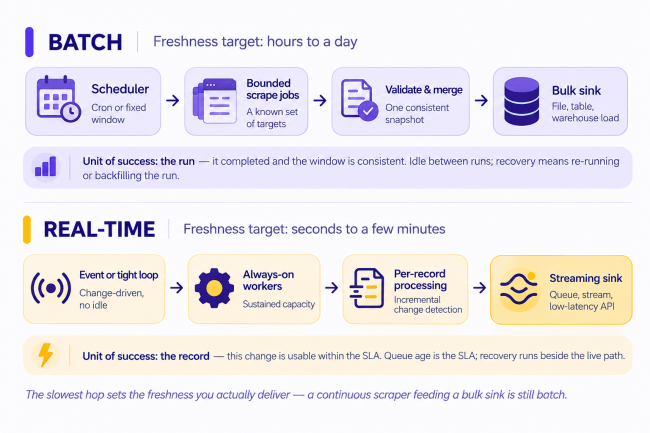
Moving from the first shape to the second changes four things that are easy to underestimate.
Queues stop being buffers and become latency surfaces. In batch, a deep queue is harmless as long as the window closes on time. In real-time, queue depth is your SLA. You need to monitor the age of the oldest in-flight item, not just the count, and you need backpressure so that a slow downstream slows intake instead of quietly accumulating hours of staleness.
The sink has to accept a continuous small-write pattern. Warehouses and object stores are built for bulk loads; pushing single records into them is slow, expensive, or both. Real-time delivery usually means a stream or queue, with the bulk store fed from it rather than instead of it.
Late and out-of-order data becomes a normal case. Retries, connection resets, and per-target backoff mean records arrive in an order the source never produced. Timestamps have to describe when the change happened, not when you wrote it, and consumers need to tolerate a correction arriving after the value it corrects.
Change detection has to be incremental. A nightly job compares a full snapshot against the previous one and derives additions, updates, and removals with confidence. A continuous pipeline maintains that state as it goes, comparing each result against current known state – more code, and code that has to be right under concurrency.
A fast scraper with a slow sink is still batch
Fetch cadence and delivery mode are independent choices, and the SLA is set by the slowest hop. If you collect continuously but publish an hourly file, your consumers have an hourly product no matter how the collection layer is built. Before claiming real-time, measure end to end, from change at the source to the moment a consumer can read it.
Throughput, scheduling, and processing
Throughput is shaped differently rather than simply being higher in one model. Batch concentrates load into a window: size for the peak inside it, pay nothing between runs. Real-time needs sustained capacity at the arrival rate, plus burst headroom, all the time.
Scheduling in batch is a calendar – cron expressions, windows, dependencies between runs. In real-time it becomes a policy question: which entities are watched, how tightly, and how work is spread so nothing starves while a noisy subset consumes the workers. With a cyclical design the interval is a hard floor on freshness: a 60-second cycle means an average record age of roughly 30 seconds and a worst case of 60 plus processing, no matter how fast the fetch is.
Processing is where fake real-time gets exposed. A batch pipeline can lag inside its window and still deliver on time. A continuous pipeline must keep pace with arrivals on average; if it doesn’t, lag grows for as long as the imbalance lasts rather than settling at some higher number. Capacity that is “usually enough” is a freshness SLA that fails during exactly the peaks you care about most. A useful sizing exercise is to separate coverage from cadence: how many targets must be collected, and how often must each one be revisited? A million-page nightly crawl and a ten-thousand-page one-minute cycle put different pressures on the system. Our guide to web scraping at scale examines the coverage side of that equation: partial completion, recovery, and measuring how much usable data actually arrives.
Reliability looks different in each model
Neither approach is more reliable. They fail differently, and you should pick the failure mode your team can operate.
In batch, the unit of recovery is the run. A failed run is re-run; a partial one is backfilled. Give each run an identifier, make loads idempotent, and a failure becomes a scheduling problem that consumers may never see, because you fixed it before the next publish.
In real-time, there is no window to hide in. A failure is a visible gap in a feed someone is acting on. Recovery needs a catch-up path that does not stall the live path – otherwise repairing an outage makes current data late too, and you extend the incident instead of ending it. And because you retry at least once to avoid losing records, consumers must absorb duplicates.
Absence is the subtler difference. When a target is missing from a single cycle, a continuous pipeline can’t tell “this listing was removed” from “this request was blocked.” Deleting on first absence produces flapping, with items vanishing and reappearing every few minutes; the standard fix is to tolerate a few consecutive misses before treating something as gone. Batch avoids much of this by comparing complete snapshots, where absence is far less ambiguous – a genuine reliability advantage that deserves weight in the decision.
Before treating absence as a change, validate what came back. An HTTP 200 containing a challenge page is a failed observation, not evidence that a product disappeared. Understanding why web scrapers get blocked helps distinguish access failures from genuine empty results, so collection gaps don’t become false business signals.
Comparison: real time vs batch scraping at a glance
Read the table as a consequence chain rather than a scorecard: the freshness row is the requirement, and every row beneath it is what that requirement costs.
When batch is the right architecture
Batch is the correct answer, not a fallback, whenever a delay of hours doesn’t change what anyone does:
- Catalog enrichment. Descriptions, specifications, images, and categories change rarely. Re-collecting nightly is cheap and gives you a coherent view of the whole catalog.
- Periodic analysis and reporting. Weekly assortment comparisons or monthly share analysis depend on clean period boundaries. A stream makes those boundaries harder, not easier.
- Historical and training datasets. You want reproducible, versioned, point-in-time cuts – precisely what a run produces.
- Expensive or fragile targets. Heavy pages and strict rate limits reward scheduled, off-peak, politely paced collection.
- Contractual or compliance cadences. When the agreement says daily, daily is the specification.
The payoff is operational. Bounded runs start, finish, can be re-run, and cost nothing while idle. Choosing batch deliberately buys simplicity you can spend on data quality or coverage instead.
When you actually need real-time
The test is behavioral: does a delay of X minutes change an action? If yes, you have a real-time requirement.
- Price monitoring feeding automated re-pricing or bidding.
- Inventory and availability, where in-stock flips drive fulfillment or ad spend.
- Time-boxed events – ticket drops, auctions, flash sales, live odds – where the data has a short half-life by construction.
- Detection and alerting, such as fraudulent listings or unauthorized content, where the SLA is part of the promise.
- On-demand lookups, where a user or an agent triggers collection and waits. The requirement here is a page-load budget rather than a continuous feed, which makes it the cheapest form of real-time to justify.
If nothing and nobody acts inside the window, you don’t have a real-time requirement. You have a preference for a dashboard that updates while you watch it.
Near-real-time and hybrid: where most systems land
Between the two poles is minutes-level collection, where a large share of production pipelines settle. Architecturally it resembles batch – a scheduler, cycles, familiar recovery – tuned with shorter intervals and incremental delivery, and it captures most of the business value of freshness at a fraction of the operational weight.
Hybrids are equally normal, because freshness is a property of a dataset or even a single field, not of a company:
- Tier by value. Top SKUs every minute, the long tail daily.
- Split by volatility. Price and stock on the fast path; descriptions and images nightly.
- Slow discovery, fast monitoring. Crawl for new URLs on a schedule, watch the known ones tightly.
- Batch as the backstop. Run the live path for freshness and a nightly reconciliation run to close gaps and correct drift. This pairing is common precisely because it lets the streaming path be fast without also having to be perfect.
Setting one global SLA for everything is how teams end up paying real-time prices for batch value, or the reverse.
Operating that mix means coordinating schedules, retries, monitoring, and delivery across workflows with different freshness targets. Bringits Stream brings those controls into a visual workflow builder, with immediate or scheduled execution and delivery to APIs, webhooks, or storage. The freshness requirement still comes first: define when each dataset must be usable, then configure and monitor the flow against that target.
Takeaways
- Start from the freshness SLA. How old may a record be when someone acts on it? Everything else follows.
- Batch is the default when a delay doesn’t change the decision – and its snapshot semantics and simple recovery are advantages, not consolation.
- Real-time is a delivery contract. The trigger, the processing, and the sink all have to honor it; the slowest hop sets your actual latency.
- Choose the failure mode you can operate. Re-run a window, or run a catch-up path beside a live one that can’t pause.
- Near-real-time and hybrid are the normal answer, not a lack of commitment. Different datasets and fields deserve different SLAs.
- Don’t confuse freshness with scale. How much you collect and how fresh it must be are separate problems with separate solutions.