Free Proxies: You Are the Product

Every engineer who’s ever built a scraper has, at some point, opened a browser tab, pasted “free proxy list” into Google, and grabbed a chunk of IP:PORT pairs off some site that hasn’t been redesigned since 2014. It works, for about ten minutes. Then half the list is dead, the other half is rate-limited into oblivion, and you’re back to square one wondering if this was ever a good idea.
Short answer: sometimes it is. Mostly it isn’t. Here’s the breakdown, without the marketing spin.
What a free proxy actually is
A proxy is just a machine that relays your request and hands back the response, so the target site sees the proxy’s IP instead of yours. Free proxies fall into two buckets:
- Public/open proxy lists — scraped or crowdsourced IP:port pairs, no registration, no accountability, no idea who’s actually running them.
- Free tiers from paid providers — a limited amount of bandwidth or a handful of IPs from a company that also sells the paid version. Oxylabs, Webshare, and a few others do this.
These two buckets are not the same product, and conflating them is where most of the bad experiences come from.
The pros (yes, there are some)
Zero cost, zero commitment. If you’re testing whether your scraper’s IP-rotation logic works, or verifying that a request goes through a proxy at all, you don’t need a residential IP pool costing $2.5–$4/GB. A free IP is fine for a smoke test.
Learning and prototyping. If you’re new to proxies and want to understand headers, request routing, or how SOCKS5 differs from HTTP proxies practically, free lists are a low-stakes sandbox. Nobody’s paged at 3am because your test script hit a dead IP.
Regional access, occasionally. Need to check what a page looks like from a different country for five minutes? A free proxy can get you there, assuming the one you picked is (a) still alive and (b) not already blocked by the target site.
Free tiers from real providers are a different story. Managed free plans — Webshare’s 10 datacenter proxies / 1GB per month, Oxylabs’ 5 free datacenter IPs — are actually solid for prototyping, because someone with an SLA and a reputation is running the infrastructure. You’re not gambling on an anonymous server; you’re using a scaled-down version of a real product.
The cons (this is the part that matters)
Reliability is genuinely bad. ScrapeOps ran a test across 1,200+ free proxies from four providers and measured success rates averaging under 5%, with some providers hitting 0% in focused runs. If your pipeline depends on consistent throughput, public free proxies will make you miserable. IPs die mid-session, get blacklisted within hours, and share bandwidth with however many other people found the same list.
No encryption, no guarantees. A peer-reviewed study of 443 free proxy services found that 79% modified user traffic in some way — injecting ads, tracking scripts, or stripping HTTPS outright. Around 92% of publicly listed free proxies don’t support HTTPS at all. That means anything you send through one — headers, cookies, form data — can be read or altered in transit.
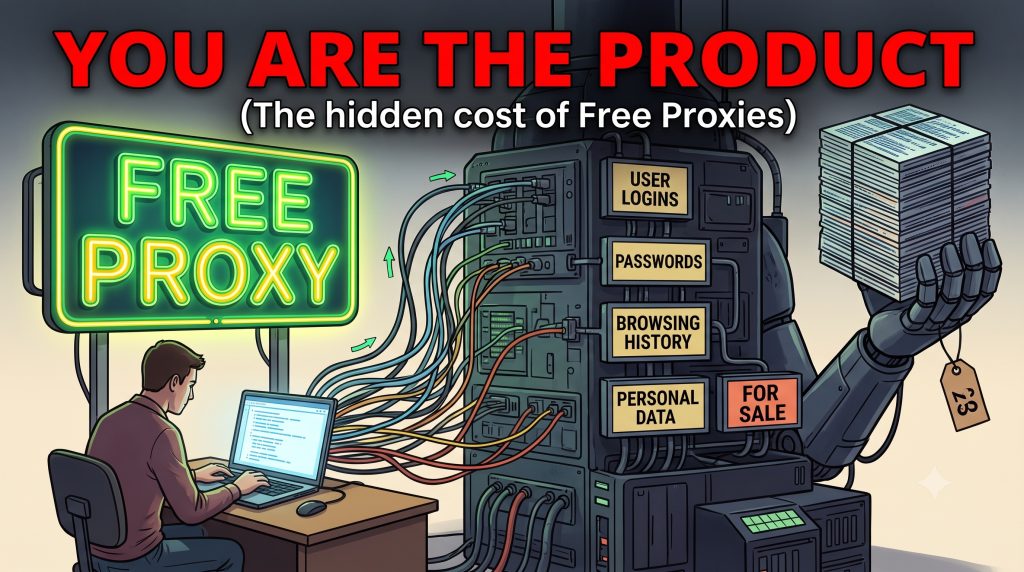
You don’t know who’s on the other end. This is the real issue. A free public proxy is run by someone, and that someone has to pay for the server somehow. Common monetization: logging and reselling your traffic, injecting malware or malicious scripts, or straight-up credential harvesting via cookie theft. “If you’re not paying for the product, you’re the product” is a cliché because it’s accurate here.
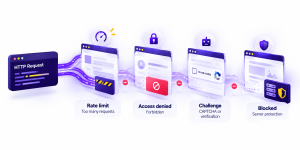
They get flagged fast. Public proxy IPs are shared across thousands of users and usually already appear on abuse blocklists that target sites check against. If you’re scraping anything with basic bot detection, expect CAPTCHAs or outright blocks almost immediately — the IP reputation is often already burned before you even start.
No support, no SLA, no accountability. When (not if) something breaks, there’s no one to call. For a side project, that’s an inconvenience. For anything feeding a production pipeline or a paying customer, it’s a liability.
Where this shows up in real scraping infrastructure
In modern web scraping, proxy management becomes significantly more complex as collection scales. If you’ve built or maintained a scraping stack at any real scale, you’ve already hit the actual cost of “free” proxies — it’s just not measured in dollars. It’s measured in engineering time: rotating dead IPs, building retry logic around random failures, writing detection for silently modified responses, and debugging why a pipeline that worked yesterday is returning garbage today because a proxy operator started injecting content into your responses.
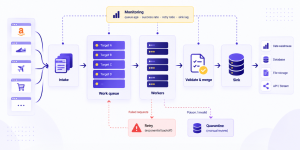
This is exactly the problem that pushes teams toward managed data collection platforms instead of stitching together proxy lists, rotation logic, and parsing by hand. A web data unblocker can handle the complexity of IP rotation, fingerprint management, CAPTCHA handling, and anti-bot adaptation directly within the collection layer, so engineers aren’t maintaining a separate proxy management system on top of everything else. Whether you get there with Bringits or another vendor, the point stands: the moment reliability, data integrity, or scale actually matter, “free” proxies stop being free — you just start paying in engineering hours instead of invoice line items.
The practical takeaway
Use free proxies for what they’re good at: quick tests, learning, and disposable one-off checks with nothing sensitive on the other end. Never route anything authenticated — logins, sessions, API keys — through a public free proxy. If you want free without the risk, use a managed provider’s free tier, not a scraped list from a random site.
And if you’re past the prototype stage and actually depend on this working, budget for it. Reliable IPs, encryption, and someone accountable when things break aren’t optional once proxies are part of a production system — they’re the actual product you’re paying for.
Questions about free proxies
Straight answers on reliability, safety, and when it's actually fine to use a free proxy.
What's the difference between a public free proxy list and a free tier from a paid provider?
Public/open lists are scraped or crowdsourced IP:port pairs with no registration and no accountability. Free tiers from providers like Webshare (10 datacenter proxies, 1GB/month) or Oxylabs (5 free datacenter IPs) are a scaled-down slice of a real paid product, backed by a company with an SLA and a reputation.
How reliable are free proxies?
Not very. ScrapeOps tested over 1,200 free proxies from four providers and measured average success rates under 5%, with some providers hitting 0% in focused runs. IPs die mid-session and get blacklisted within hours.
Are free proxies safe to send data through?
Generally no. A peer-reviewed study of 443 free proxy services found 79% modified user traffic in some way, such as injecting ads or tracking scripts, or stripping HTTPS. About 92% of publicly listed free proxies don't support HTTPS at all.
Who actually runs a free public proxy, and why?
Someone has to pay for the server, so free proxies are commonly monetized by logging and reselling traffic, injecting malware or malicious scripts, or harvesting credentials via cookie theft.
Why do free proxies get blocked so quickly by target sites?
Public proxy IPs are shared across thousands of users and usually already appear on abuse blocklists that target sites check against. Scraping anything with basic bot detection tends to trigger CAPTCHAs or blocks almost immediately, since the IP's reputation is often already burned.
When is it actually okay to use a free proxy?
For quick tests, learning, and disposable one-off checks with nothing sensitive involved, like verifying your IP-rotation logic works. Never route anything authenticated, such as logins, sessions, or API keys, through a public free proxy.
What's the real cost of "free" proxies at production scale?
It's measured in engineering time, not dollars: rotating dead IPs, building retry logic around random failures, writing detection for silently modified responses, and debugging pipelines broken by a proxy operator injecting content.
What's the alternative once free proxies aren't enough?
A managed data collection platform. Bringits, for example, bundles IP rotation, fingerprint management, and CAPTCHA handling directly into the collection layer, so engineers aren't maintaining a separate proxy management system on top of everything else.